Two-stage vs single-stage furnace: which should you buy?
What the second stage does and whether it is worth the extra cost.
Reviewed by Abdullah Ghzail, licensed gas technician•Last checked November 2026
Quick answer: A two-stage furnace runs on low heat most of the time and switches to high only in very cold weather. It gives quieter, more even heat than a single-stage furnace. At Hawana the difference is about $100, from $3,500 for single-stage and $3,600 for two-stage, so two-stage is usually worth it.
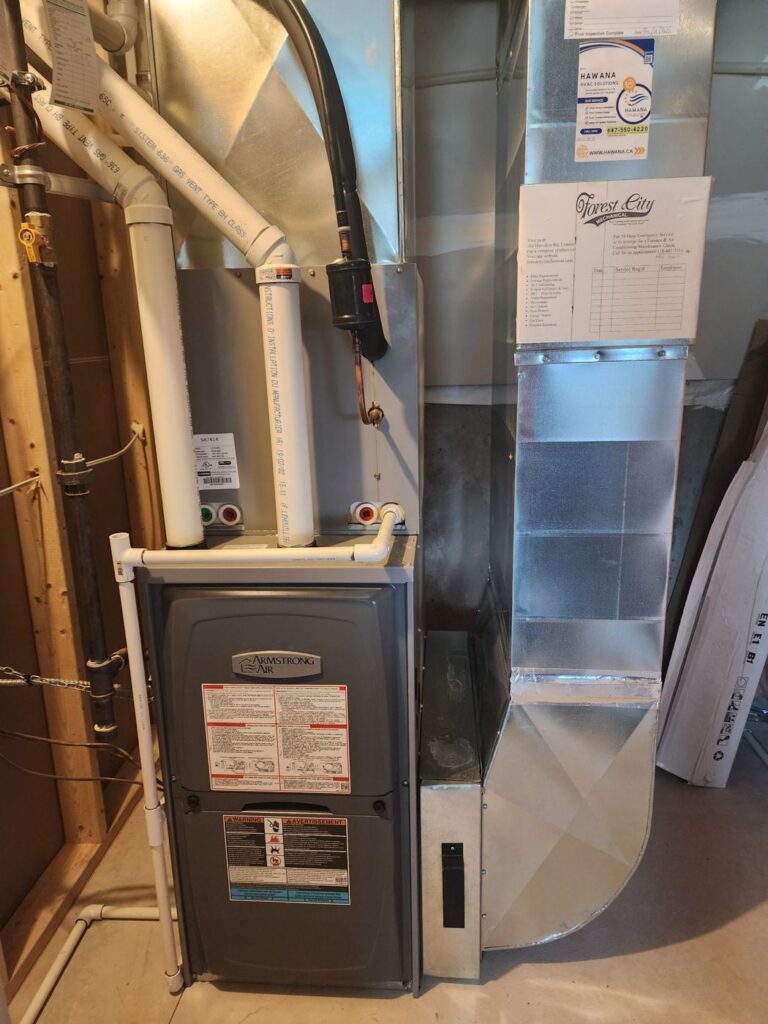
How they differ
| Single-stage | Two-stage | Modulating | |
|---|---|---|---|
| Burner | Full power or off | Low (about 65%) and high | Many small steps |
| Comfort | Warm blasts, then cooling off | Longer, gentler cycles | Most even |
| Noise | Loudest | Quieter on low | Quietest |
| Gas saving | Baseline | Small | Small |
| Price | Lowest | A little more | Highest |
Why two-stage feels better
Most winter days need only part of the furnace's power. On low stage it runs longer at a lower output, so room temperatures swing less, air is filtered and mixed more, and the blower is quieter.
Does it save gas?
Only a little. Both are 96% efficient. The benefit is comfort, not the bill.
When single-stage is fine
- A small home or a condo townhouse
- A rental property
- The tightest budget
Thermostat note
A two-stage furnace works with a regular thermostat using its own timer, or with a two-stage thermostat for better control.
Common questions
Is a two-stage furnace worth the extra money?
Usually yes. The extra cost is small and the heat is quieter and more even.
Does a two-stage furnace save money?
Very little on gas. It may use slightly less electricity with an ECM blower.
Do I need a special thermostat for a two-stage furnace?
No, but a two-stage thermostat gives the best control.