Hot water runs out fast: 6 causes and fixes
Why a tank that used to last no longer does.
Reviewed by Abdullah Ghzail, licensed gas technician•Last checked November 2026
Quick answer: Hot water that runs out quickly is most often caused by a broken dip tube, a failed lower heating element on an electric tank, heavy sediment in the tank, a thermostat set too low, or a tank that is simply too small for the household. On a tankless heater the usual cause is scale or a clogged inlet filter.
The six causes
| Cause | Clue | Fix |
|---|---|---|
| Broken dip tube | Lukewarm water almost at once; small white plastic bits in tap screens | Replace the dip tube |
| Failed lower element (electric) | Short supply of hot water, then cold | Replace the element |
| Sediment | Rumbling or popping; tank over 8 years old | Flush, or replace an old tank |
| Thermostat too low | Water never very hot | Set to about 49 to 60°C |
| Tank too small | Runs out only on busy mornings | Bigger tank or tankless |
| Mixing valve or crossover fault | Warm water at cold taps | Repair the valve |
Tankless heaters
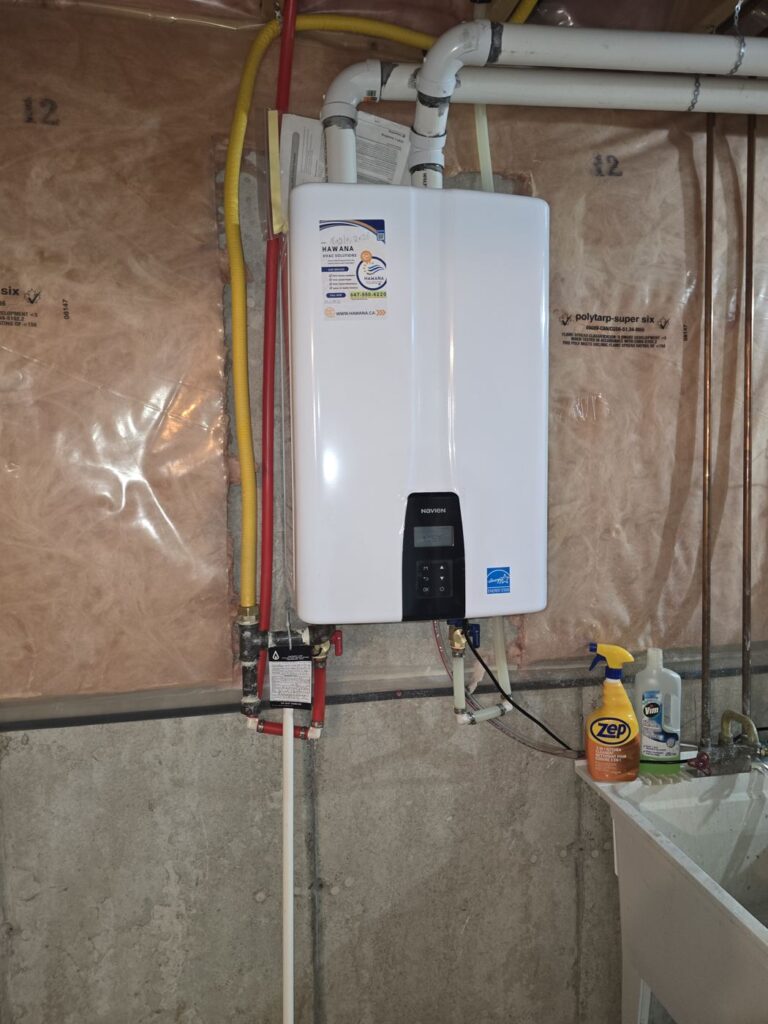
A tankless should not run out. If it goes cold or pulses hot and cold:
- The inlet filter screen is clogged.
- Scale has built up in the heat exchanger and it needs descaling ($199 at Hawana).
- Too many taps are open for the size of the unit.
How long should a tank last in the shower?
| Tank | Typical shower time |
|---|---|
| 40 gallon | about 20 to 25 minutes |
| 50 gallon | about 25 to 35 minutes |
| 60 gallon | about 35 to 45 minutes |
Low-flow shower heads stretch these times.
Repair or replace?
A tank over 10 years old with sediment problems is near the end of its life. An owned tank is from $2,900 installed and a tankless from $3,600. If it is a rental, call the rental company: repairs are included.
Common questions
Why does my hot water only last 10 minutes?
Usually a broken dip tube, a failed lower element on an electric tank, or heavy sediment taking up space in the tank.
What temperature should a water heater be set to?
About 49 to 60°C. Hotter gives more usable hot water but raises the scald risk, so many homes use a mixing valve.
Will a bigger tank fix it?
Only if the tank is healthy and simply too small. Otherwise the fault will follow you to the new tank.